


Back to all articles
The Operating Model Thesis
9
min to read
The Rebuild-First Doctrine: Restructuring Without the Layoff Boomerang
Most AI restructurings cut headcount first and hope the operating model catches up. Klarna, Ford, and Commonwealth Bank all ran that sequence and reversed the cuts, with real cost and public fallout. Carbon's Rebuild-First Doctrine says the order has to run the other way: rebuild the workflow, decision rights, and roles first, then cut, sized to what actually still needs doing.

The instinct in most AI-driven restructurings is to cut first: identify the roles AI can plausibly absorb, remove them from headcount, and let the operating model catch up later. Carbon's position runs the other way. Cuts come after the operating model is rebuilt, or the company ends up paying for the same headcount twice.
The Rebuild-First Doctrine holds that a company should never cut headcount for AI before it has rebuilt the operating model that AI is meant to run inside. Rebuild means four specific things: workflows redesigned with AI in the chain, decision rights reset, capability ownership decided, and roles rewritten. Cuts come after that new model is running and has been measured against a baseline.
This follows from a claim Carbon has made before: the operating model, not headcount or the org chart, is the real unit of capability. Technology spread freely across most companies in 2024 and 2025, but the ability to reorganize around it did not spread nearly as fast. A layoff removes headcount immediately and does nothing on its own to close that gap. A company that cuts before it rebuilds is betting the gap closes itself, on a timeline nobody has committed to. Klarna is the clearest public case of that bet failing.
What Klarna's Reversal Actually Proves
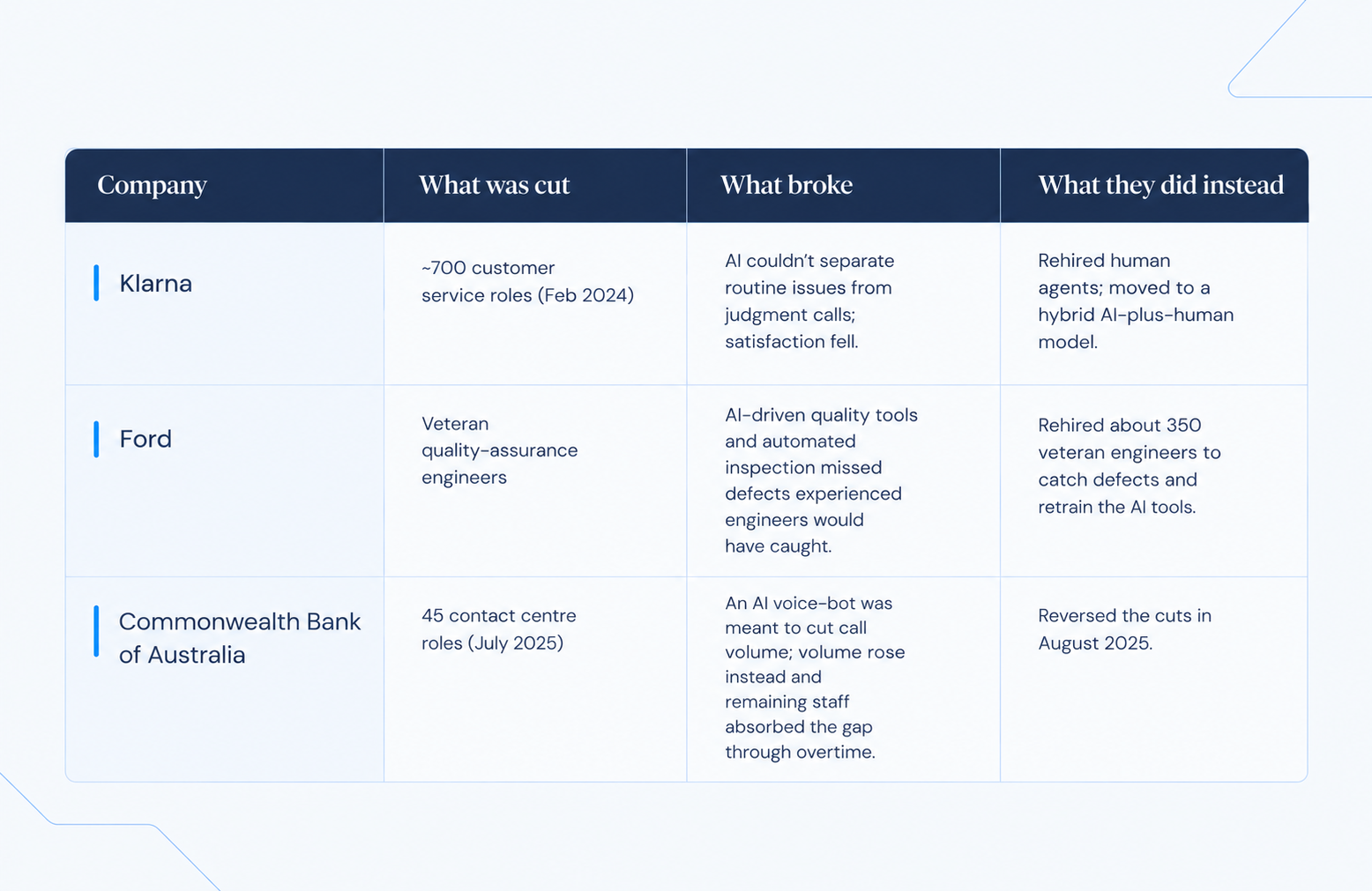
In February 2024, Klarna announced that an OpenAI-built AI assistant had done the work of roughly 700 full-time customer service agents in its first month, handling 2.3 million conversations, cutting resolution time from 11 minutes to under 2, and taking over approximately 75 percent of customer chats across 23 markets and 35 languages (Fast Company). Overall headcount fell by about 22 percent, and Klarna froze hiring for more than 12 months.
The system had absorbed volume without absorbing judgment. Customer satisfaction declined, complaints and repeat-contact rates climbed, and the AI's responses were described as technically correct and emotionally vacant: it could not reliably tell a routine refund request apart from a relationship-damaging billing dispute (The State of Brand). That's the judgment call the Rebuild-First Doctrine says has to sit with a person before the surrounding volume gets automated away — Klarna found out only after customers started complaining.
By mid-2025, CEO Sebastian Siemiatkowski reversed course. In a Bloomberg interview, he said: "We focused too much on efficiency and cost. The result was lower quality, and that's not sustainable." Klarna began rehiring human agents, including remote roles for students and rural workers, and moved to a hybrid model where AI handles routine, high-volume queries and people handle the judgment calls (The State of Brand; Forbes).
Other Companies Have Run the Same Sequence
Ford cut engineering roles tied to vehicle quality assurance, then found that its AI-driven quality tools and automated inspection systems were missing defects that experienced engineers would have caught. It rehired about 350 veteran engineers, the ones staff call "gray beards" internally, to catch the defects and retrain the tools that had missed them (The Next Web). It's the pattern that broke Klarna's model, applied to a physical product instead of a conversation: a system trained on known defect types can't catch one it's never seen.
Commonwealth Bank of Australia cut 45 contact centre roles in July 2025, betting an AI voice-bot would cut call volume. Call volume rose instead, and the staff who remained were put on overtime and pulled off other duties to cover the gap. CBA reversed the cuts the following month, telling staff it had "not adequately considered all relevant business considerations" when it made them (ABC News; Bloomberg). CBA had sized the cut to a forecast of what the voice-bot would deliver. The roles were gone before there was a working system to check that forecast against.
Groupon, GitLab, and Meta are further along the same cut-first sequence, with no confirmed reversal yet (TechCrunch) — exposure rather than proof, but the kind of exposure Klarna, Ford, and CBA already paid for.
The scale suggests a broader pattern rather than three or four unlucky companies. Forrester Research found that 55 percent of employers regret AI-attributed layoffs (Predictions 2026: The Future of Work, published December 19, 2025; HR Executive). A Robert Half survey of nearly 2,000 U.S. hiring managers found that 32 percent had eliminated a role primarily due to AI and later rehired for the same or a similar position, with the reversal rate highest in finance at 44 percent (IBTimes UK).
The Doctrine Applies Whether AI Caused the Cut or Just Justified It
Gartner has stated publicly that less than 1 percent of layoffs announced in the first half of 2025 were attributable to actual productivity gains from AI (Gartner). At the same time, AI-linked job cuts tracked by Challenger, Gray & Christmas climbed from 7 percent of all announced U.S. layoffs in January 2026 to nearly 40 percent by May, with 87,714 AI-linked cuts in the first five months of the year alone, more than the combined AI-linked totals for 2024 and 2025 (13,089 and 54,836, respectively) (CNBC, citing Challenger, Gray & Christmas). Read together, those figures suggest a meaningful share of announced "AI layoffs" are cuts a company had other reasons to make, filed under AI because that's currently the more defensible story to tell a board than a revenue miss or a cost overrun.
The distinction changes how you diagnose a cut. It doesn't change what fixes it. A restructuring fails the same way whether AI is the real driver of the cut or the cover story for one: headcount is removed before the workflows, decision rights, capability ownership, and role design that would let the organization run without it have actually been rebuilt. Klarna, Ford, and CBA all had real AI systems in the loop, and all three still failed for a sequencing reason that had nothing to do with whether the technology worked. A company using AI as cover for a cut it wanted to make anyway ends up carrying the identical risk: fewer people, no redesigned workflow to absorb the load.
What an AI-Layoff Reversal Costs a CFO
An AI-layoff reversal shows up on the P&L in ways a headline doesn't capture. Severance gets paid once for the original cut, and then the company runs a full hiring cycle again — recruiting, interviewing, onboarding, ramp-up time — none of it in the original business case. Tacit knowledge is harder to price but no smaller a cost: the employee who knew which exception cases came up every quarter doesn't hand that over in an exit interview, and a replacement rebuilds it through the same trial and error, on no compressed schedule. Customer relationships take damage in the gap between the cut and the reversal, which for Klarna, Ford, and CBA all played out in public. And there's a pay premium required to win back comparable skill — reports describe it as significant without agreeing on a figure, so treat it as directional rather than a number this piece can verify. The common thread: a company that cut a role and now needs it back is negotiating from a weaker position than it held before the cut.
A PE operating partner carries an additional cost the CFO of a standalone company doesn't: the fund's hold period. A boomerang doesn't just cost a rehire cycle. It costs time the fund can't recover before an exit, and credibility with a management team that has to explain a reversal to its own staff. The risk isn't limited to portfolio companies either. Vista Equity Partners has told staff that headcount across its roughly 700-person firm and its portfolio companies' combined 10,000 employees could fall by as much as a third as it automates operational, analyst, and investor-relations work (InvestmentNews) — a reminder that the sponsor isn't exempt from this either.
The Four Requirements of a Rebuild
Rebuild breaks into four specific things that have to happen before a single role is cut.
Redesign the workflow. The first is a workflow built around where AI's judgment ends, not around where its throughput begins. Klarna's failure is the clearest illustration: AI absorbed volume with no redesigned handoff for the cases it couldn't judge, so the exceptions kept arriving at a front line that had already been cut. Getting this right means mapping the workflow before deployment: which requests are genuinely routine, which ones look routine but carry a judgment call inside them, and who receives the second kind once volume shifts.
Reset decision rights. The second is naming, explicitly, who owns a decision once AI handles the routine version of it. IBM's AskHR system shows what getting this right looks like: it resolves about 94 percent of incoming HR requests cleanly, and rather than leave the remaining 6 percent, many involving ethical or judgment calls, as an open question, IBM redesigned entry-level roles around customer engagement, product development, and AI oversight, and is tripling its U.S. entry-level hiring in 2026 to staff them (Inc.; HR Executive). Deciding who holds a right depends on knowing who holds it today, which is the work the Audit-First Doctrine exists to do: process reality, data lineage, decision rights, and dependency mapping, established before anything gets redesigned. Skip that audit, and decision rights get reset on a guess instead of what the audit found — the exact gap Carbon's Cultural Reset Doctrine addresses when the reset doesn't carry through the culture, not just the org chart.
Define ownership. The third is deciding, before any role is cut, what AI owns outright, what a person owns outright, and what requires escalation between the two, written down specifically enough to survive an edge case rather than left as a question discovered after the cut, usually at the moment a customer or regulator is asking who signed off on a bad answer.
Rewrite the roles. The fourth is rewriting roles around the line that actually determines whether a cut holds: augmentation versus automation. Roles where AI augments a person's judgment tend to survive restructuring. Roles built on the assumption that AI fully replaces the task tend to be the ones that get reversed, because the judgment the role used to provide doesn't disappear when the role does; it goes unhandled until a customer or a regulator notices. A company that cuts a role before rewriting it around that split is choosing to eliminate work it hasn't mapped.
Cuts Come After the New Model Is Running
Rebuild runs first. The new operating model runs and is measured against a baseline, and only then does headcount change, sized to what the model needs rather than to a guess made before anyone knew. CBA sized its cut to a forecast of what the voice-bot would achieve, a forecast nobody could have tested without first running the system and watching what happened to call volume.
IBM ran that order correctly: the redesign happened before the hiring decision, which is why its 94 percent automation rate led to expanded, deliberate hiring rather than a reversed cut. Everyone else in this piece ran it backward.
This is the sequence Carbon runs before it designs anything: Strategy & Shaping maps the workflow and names where AI's judgment ends before deployment starts, and Governance & Oversight assigns decision rights and escalation paths in that same phase, not after a customer or regulator forces the question. A company weighing an AI-driven headcount decision right now has one thing worth checking before anything else: can it name, today, who owns the judgment call when the routine version of the work gets automated. If the answer isn't clear, that's the gap to close before a single role is cut.

Carbon builds nearshore engineering Hubs and embeds AI capability inside client operations, for scaling technology companies and PE-backed organizations. Operational infrastructure, built to last.
Own the Build™


Own the build.
Start with a conversation.
Get in touch

What to read next


Own the build. Start with a conversation.
Get in touch

Own the Build™