Your request has been sent
Your copy is on its way. We will follow up within 48 hours to see if you have any questions.


.webp)
The Carbon Way
Our methodology for building and transferring capability
Engineering standards shaped by experience at:











One standard: lasting capability you own. Two delivery models:
Hubs build engineering organizations.
Pods deploy AI into operations.
Carbon Hubs


Primary Need
Scale or restructure durable engineering capacity
Carbon Deploys
Governance, legal, leadership, hiring, and operating infrastructure.
Client Owns
The engineering organization, IP, systems, and operations
End State
A self-sustaining engineering organization transferred to the client
Carbon AI Pods

.svg)
Primary Need
Move AI from idea or pilot into production
Carbon Deploys
A multidisciplinary AI team, production system, redesigned workflows, and governance
Client Owns
The system, workflows, knowledge, governance, and ongoing operating responsibility
End State
A production AI capability operated by the client after the Pod exits
Build. Operate. Transfer.
A three-phase model. Designed to reduce risk, build operational maturity, and prepare the Hub for long-term ownership.
Build: Structured at Formation
Before the first engineer joins, the operating model is already in place. Every structural decision is made at formation, not retrofitted. How the team is shaped, how leadership is architected, how governance and compliance are handled are all resolved before a single hire is made.

Cross-Border Expertise
Building moves faster when local market knowledge is already in place. Entity selection, employment framework, talent pool. Each decision shaped by experience operating in the region.

Designed for Operation
By the end of Build, the Hub is structurally complete and operationally ready. Phase 2 begins with a fully formed Hub.
Phase 1
Operate: Managed Scaling
Once formed, the Hub operates under Carbon's oversight, measured against the delivery expectations, performance standards, and ROI benchmarks established during the Build phase.
.webp)
Vendor Independence
Vendor dependencies are systematically eliminated as internal capability replaces external reliance. Regular audits give you and your board the reassurance that the Hub is performing as designed.

Designed for Transfer
The objective is a Hub ready to operate without us. Scaling cleanly, holding its value, and requiring no structural intervention at the point of Transfer.
Phase 2
Transfer: Ownership Without Disruption
Transfer is not a moment. It is the final phase of a process that begins months before ownership changes hands.

Cross-Border Expertise
Structured handover sessions and formal training programs ensure key stakeholders are equipped before transition. Institutional knowledge is retained. HR and leadership functions transfer with the Hub, ensuring continuity rather than disruption.

Designed for Ownership
We build every Hub to run without us. That is the only measure of success we accept.
Phase 3
Rigorous Selection. Inside Governed Systems.
Exceptional engineers without structure rarely reach their full capability. A governed Hub is only as strong as the people and practices inside it.
.svg)
Verified Before Formation
Every engineer is sourced from the top of the European engineering pool. Experienced engineers from category-leading technology companies. Product thinking, architectural maturity, business fluency, and cultural fit verified before every offer is made.
Standards That Compound
Carbon's engineers are equipped with modern AI tooling. Cursor, Copilot, and a full stack of specialist tooling are part of how they ship, not a side experiment. The per-engineer output floor is structurally higher than in a conventional team.
Built to Last
The hiring bar set on formation is the bar every subsequent hire meets. The standard established on day one becomes the standard the organization keeps.

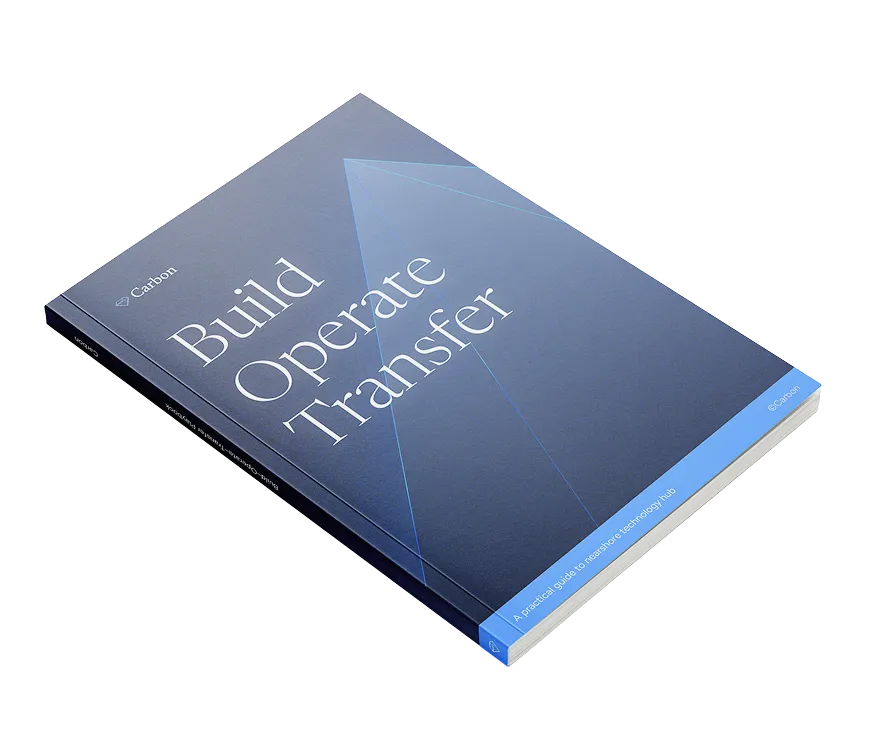
Want the full picture?
Download our Build–Operate–Transfer Playbook, a practical guide to nearshore technology hub formation covering market selection, governance frameworks, AI capability integration, operating model design, the transfer process, and real-world outcomes.
For leaders rethinking how their engineering function operates.
Prove. Operate. Deploy
AI transformation specialists that embed inside your business, redesign the workflows that matter most, and build the systems that change how you operate.
Prove
Discovery starts where you are. With a defined business case, we pressure-test it. Without one, we audit the business, find the highest-value workflows, and build the case from scratch. What gets built is defined here. So is how it gets measured.
Phase 1
Operate
Operate starts with the data. Most enterprise data was never built to run AI, so Carbon first restructures it into something usable. From there, we build whatever moves the business forward. Your strongest people get faster and more valuable. The rest of the work gets carried by the system.
Phase 2
Deploy
The AI Pod builds the production system inside your environment. No off-the-shelf platforms, no pre-packaged solutions. Measurement runs from day one against metrics set in Prove. The engagement closes when the transformation holds.
Phase 3
The People Inside Every AI Pod
Most AI never reaches production. The difference is rarely the model.
It is the people deploying it.
Carbon builds Pods around specialists who have built production systems inside real businesses. Accountable to outcomes, not recommendations.

Strategy

Engineering

Deployment

Governance

Operations
Every Pod brings together these five disciplines, because successful AI transformation depends on all of them.
Embedded. Accountable. Platform-agnostic.
Embedded Inside Your Business
AI built outside the business tends to break the moment it meets the business. Carbon Pods avoid that pattern by working from within. Your operations. Your data. Your teams.
Platform-Agnostic by Design
The right architecture is different for every business. Carbon designs around your existing environment, selecting the technologies that best support your goals rather than forcing a predefined stack.
Accountable to Outcomes
Every engagement opens with a business case Carbon commits to. It closes against a measurable result tied to that same case.
A Finite Engagement. A Permanent System.
Pod engagements end. The systems they leave behind do not. No recurring fee. No vendor margin. No platform lock-in.
Own the build. Start with a conversation.
Get in touch
.svg)

Own the Build™